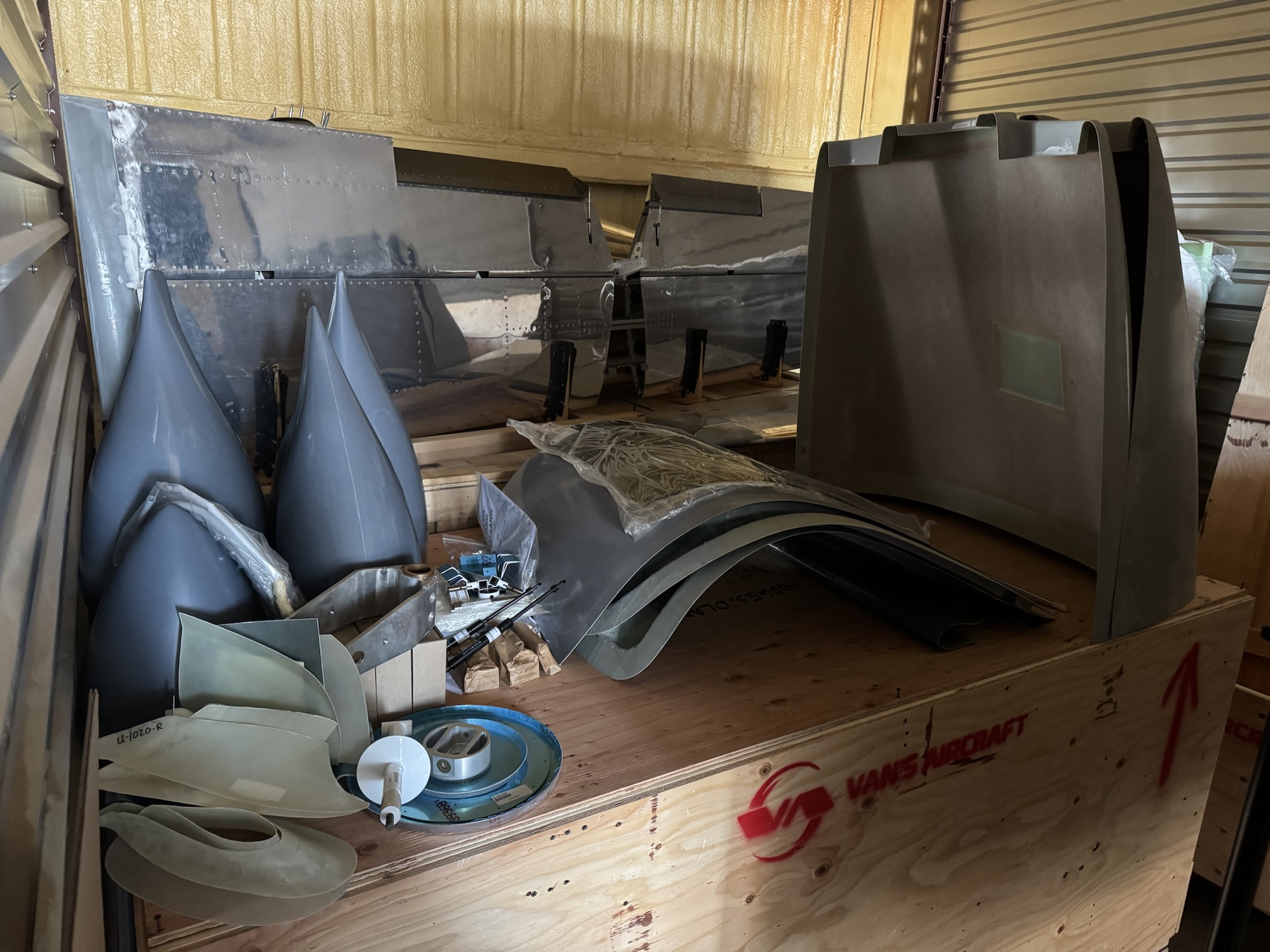
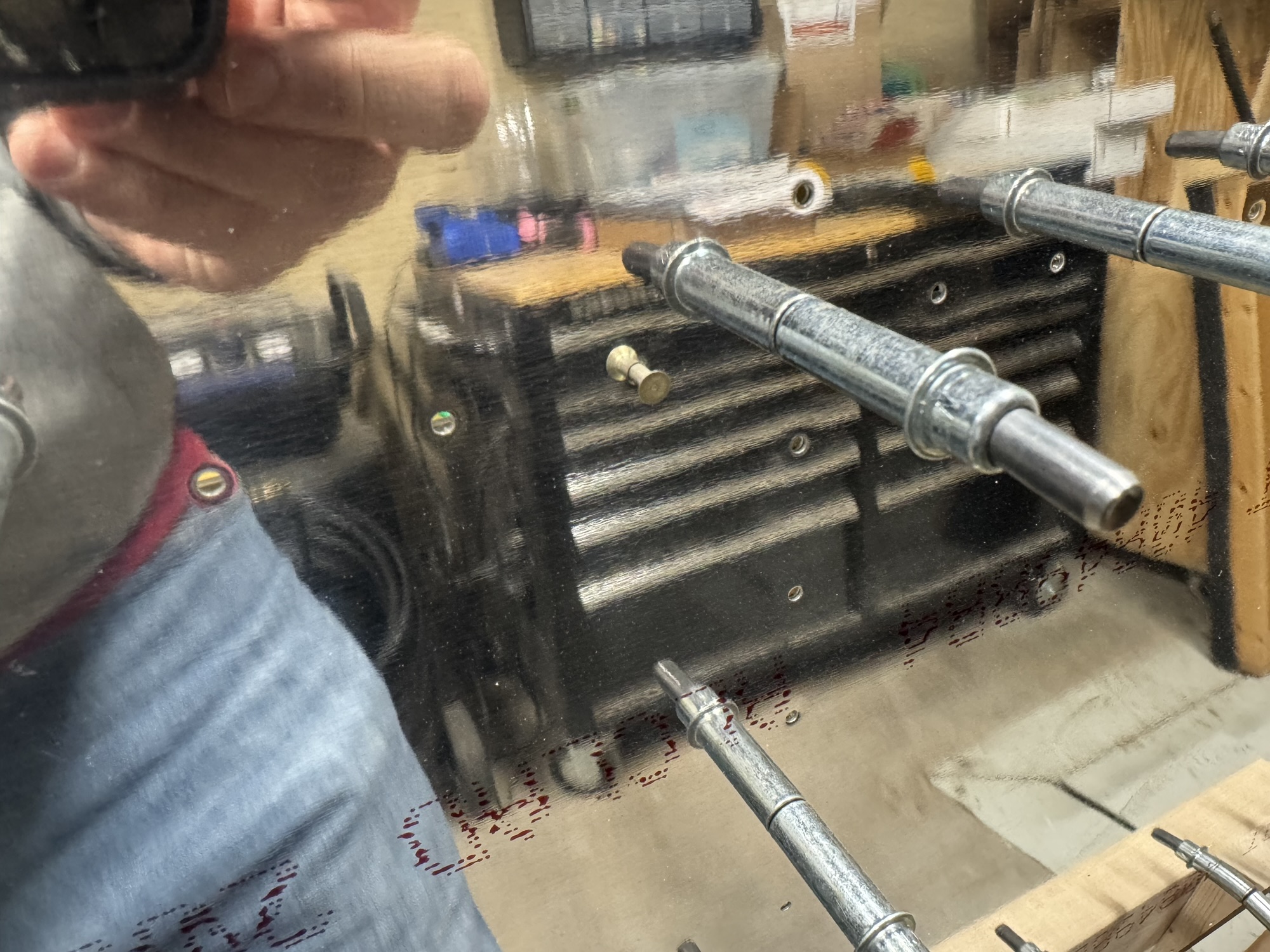
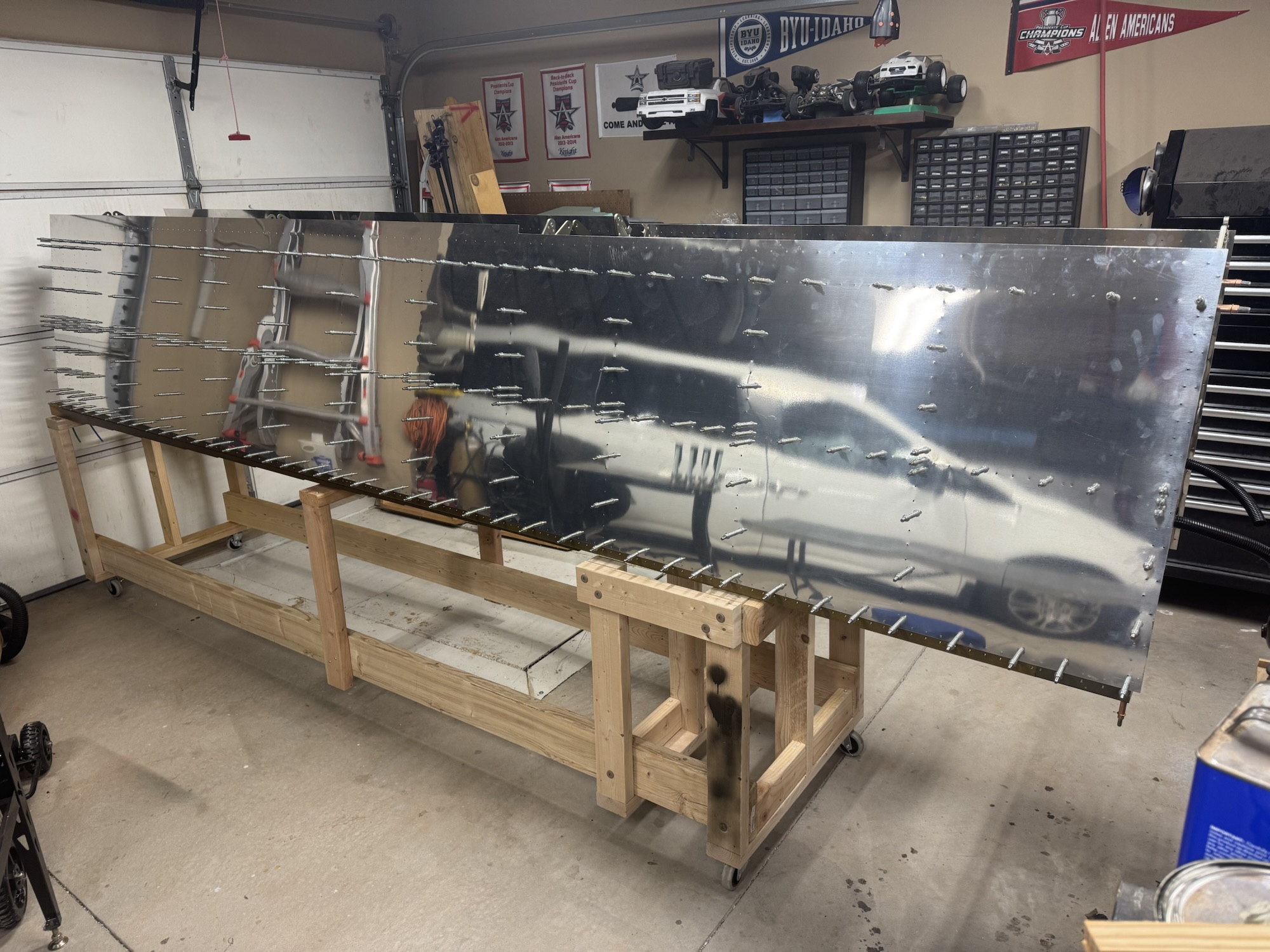
I took a few hours after work last night and went to the storage unit to inventory the kit. I did short cut the process some for some of the hardware bags by just looking to see that I had relatively the count the had on the list and then checked it off. For hardware, I can replace that myself if I find I’m short. But I made sure the actual parts of the plane were there that I needed and luckily all was accounted for! The only thing I had missing which they stated was on backorder was the seat frame kits. No clue when those will be in but luckily I’m not in a huge rush for those just yet. I hope to get the QB fuse stuff inventoried after I clear out the trash and crate from the finishing kit from the storage unit to make room.
I got a call during spring break that the fuse QB and finishing kit were ready to be picked up. This was 5-6 months ahead of schedule but definitely welcome news since September and October are usually marching band months for our family. I got time off scheduled for work, rented a 24′ enclosed trailer and planned our route. It took us ~28 hours to drive the entire route.
Our route took us up through Kansas, Colorado, through the bottom portion of Wyoming, the top tip of Utah, Idaho and into Oregon. The best part of the drive was when we got into Oregon. The route basically took us along the river between Washington and Oregon all the way to Portland. It was beautiful country!
It also ended up being towards the end of the day so we were running out of light fast, but it created the best views of the valley that the river flowed through. It was also VERY windy and took alot of concentration to make sure we didn’t deviate from our lane with the trailer pushing us around.
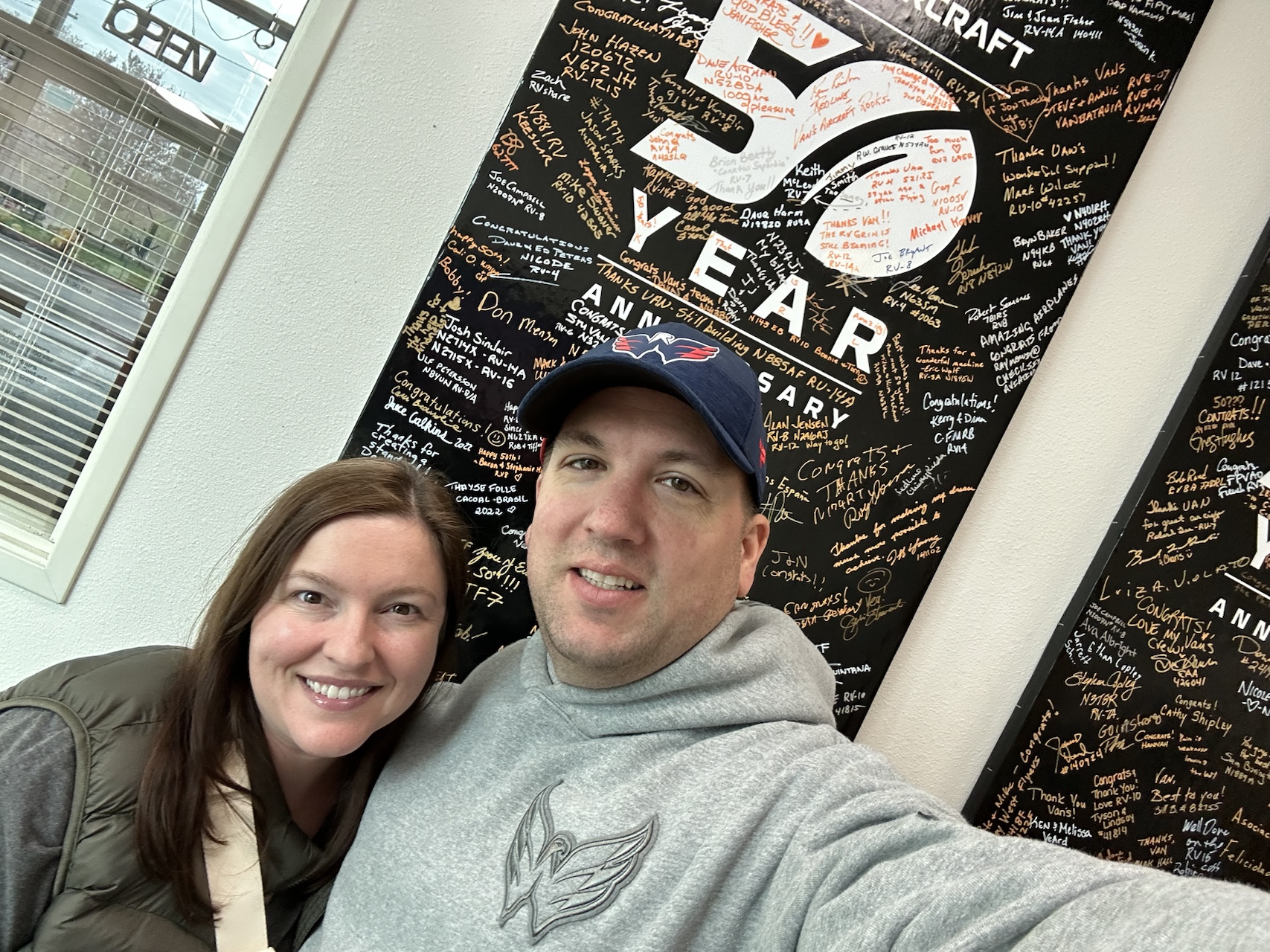
On Wednesday morning, April 2nd, we woke up and drove to Van’s Aircraft which was just south of the hotel we were staying at. We went around back and picked up the crates we came for which the warehouse worker stated were just two crates. I think he was remembering the non-QB fuselage which is one crate and the finishing kit which is the other. Luckily I checked with someone back in the building and they reminded him it was indeed three crates. That would have been very inconvenient if I had traveled all the way home missing the biggest crate which is the QB fuse. Since there wasn’t much time between learning this and the factory tour, we decided to do it after the tour and flight was completed. I forgot to take pictures of the factory while we were going through because I was so mesmerized just taking in all of the organization of parts, machinery to form components, and assemblies being completed such as spars being riveted, and even a factory built RV-12 being finalized in its assembly.
We then got the chance to go for our first flight in the RV-10! I was blessed to get this opportunity as the weather reports continually showed that it was going to be overcast and raining during that time, but thank the Lord it cleared up and we were able to go flying! When they opened the hangar I realized that the aircraft that was at Oshkosh this past year was the same aircraft that was the original yellow, blue, and white aircraft they use to demo with but it had just been redone. They had completely redone the paint and had a brand new glass panel put into the aircraft. So, if you want to see what it looked like inside, go and look at my Oshkosh 2024 post and I have videos there of the interior. I have to say that the RV is way easier to get in than any other aircraft I have flown, except maybe the Cardinal. They are very close when compared from the pilot’s perspective, but the passenger ability to get in is much better than the Cardinal. Once in, everything was well organized with the Garmin glass panels.
The performance of this aircraft was amazing! I’ve not flown in any high-performance aircraft before, but that IO-540 with the 3-blade prop made for excellent acceleration and we were off the ground very quickly even with three full sized adults! We also made it to pattern altitude very quickly with around 800 fpm climb, if not more! Keith was our demo guy, who was the guy I had talked too earlier this year about my misdrilled hole. It was good to get to actually see him in person now.
The visibility from the cockpit was amazing! I was surprised that even without a back window, I could still see pretty far behind me if I had to. The flight angle of the aircraft was also surprising. I had greater forward visibility than I’ve ever had in an aircraft. It could also have been the seat positioning, but it sure looked like the nose was lower down so I could see further forward. Also the windows going down the sides allowed me really good visibility around the nose compared to the Piper’s I’ve flown in the past. It was just amazing to watch the Garmin system manage the aircraft both from a flight control perspective with the autopilot but also from the engine management that you could see from the Garmin interface. I was also surprised at how easily their engine started up too. It was like my car with how easy it started! I’ve never had that experience before, even with the newer aircraft that I flew with Monarch Air which was only about 6-7 years old.
There’s just so much that was amazing about this aircraft and I am definitely glad that my research was spot on even without flying the aircraft LOL Kind of hard to back out now I would guess. The aircraft flew very easily. The vertical control was lighter than the roll control but it was very easy to keep the plane on track and the two finger controllability they talked about is not an exaggeration if you are just maintaining straight and level flight and making gentle turns.
We then headed back to the airport and landed. The aircraft was actually very easy to taxi on the ground even though you don’t have direct control over the nose wheel to steer around. Just a little bit of braking helped with maneuvering around.
After we got back we loaded up the final crate and we said goodbye to Van’s Aircraft! The next time I will visit them will be to show off our finished airplane to them here in the next few years!
With everything squared away, we decided to take a bit of a rest day. They recommended we go to the Evergreen Aviation Museum. It had some good displays in there, but the gem of the whole thing was to get to see the Spruce Goose. I’d seen the old news reels and pictures of the aircraft, but to see this thing in person put “massive” to a whole new level. This thing was so big! They said it was as tall as an 8 story building, which I can definitely believe. The thing took up the entire hangar with other displays littered all around it. The plywood construction was amazing to see as they had cut a hole into the plane for easy entrance to see the plane through out. I took an up-close picture of the layering and it was amazing since most of the plywood you will see in any lumber yard is often questionable. Even the best pieces that are meant for furniture or other display purposes are not as pristine as this was. Even the reinforcement brackets for gluing the components together were made out of small layers of plywood as well. It was amazing to look at! There was an old gentleman there that works at the display that wrote a book about its construction process and he had cited sources for all of the details on the planes construction. I couldn’t pass that up as it would be amazing to see how this was done.
We then went to the local Deseret Bookstore which was actually the best store we’ve been to so far. Granted we’ve not been to one in Utah, Arizona or Idaho, but I was surprised at how well this one was stocked. Even better than Dallas which I figured would have been pretty good. We then spent a good amount of time at the local temple in Portland. It was so pretty and I always love seeing the different architecture of these buildings with each place we visit.
The next day we started our long trip home. It took the same amount of time (~28 hours) and was definitely the hardest because I was excited to get the parts home and I had already been driving alot already. We had to stop at the Buc-ee’s both on our way and back so that we could enjoy that little bit of heavenly oasis on our trip. I am glad we were able to make this trip and that everything went extremely well!
When we got home, we opened the crates after getting home to make sure everything looked good. I also was able to finally complete the entire build manual in my three ring binder. I’m glad everything got home without an issue! All in all we logged just over 3,700 miles and made a ton of pit stops at all of the Love’s gas stations along the way. We burned through 484.56 gallons of diesel to get there. I wish I had tracked how much def I used but it was about 20 gallons as I had to fill up 5 times and it was about 4 gallons each time. In total I spent $1,599.79 on fuel alone. The wind was the biggest contributor to my mileage. The trailer is not very heavy, even with the crates, but the trailer has a large profile and the wind could push on it quite significantly. My average gas mileage this month was 9.115 mpg. That’s as bad as when I’m pulling the fifth wheel RV which weights just over 12,000 lbs. This trailer with the crates on it is no more than 5,000 lbs. The trailer was 3,360 lbs., the finish kit was 431 lbs., the QB fuse was 818 lbs., and the cabin cover crate was 350 lbs. We were extremely blessed thought. We didn’t hit any major weather on our trip and though the wind was strong, it wasn’t unmanageable. Also the weather cleared up for us for our flight on Wednesday and everything made it home safely with no tire blowouts on the trailer! Very grateful for all of this and I’m excited to get the wings finished, which I finally got more primer right before we took off for Oregon. I’m also still glad we went to get it so we knew the crates would make it without any damage and the parts would be safe. It was also good to go see the Van’s Aircraft facility and see where things are coming from and the quality and care they put into everything.
I got some time tonight before church to dimple the last of the left wing skins. Now I just need to prime the parts and I’ll be ready to get started on riveting them this weekend.
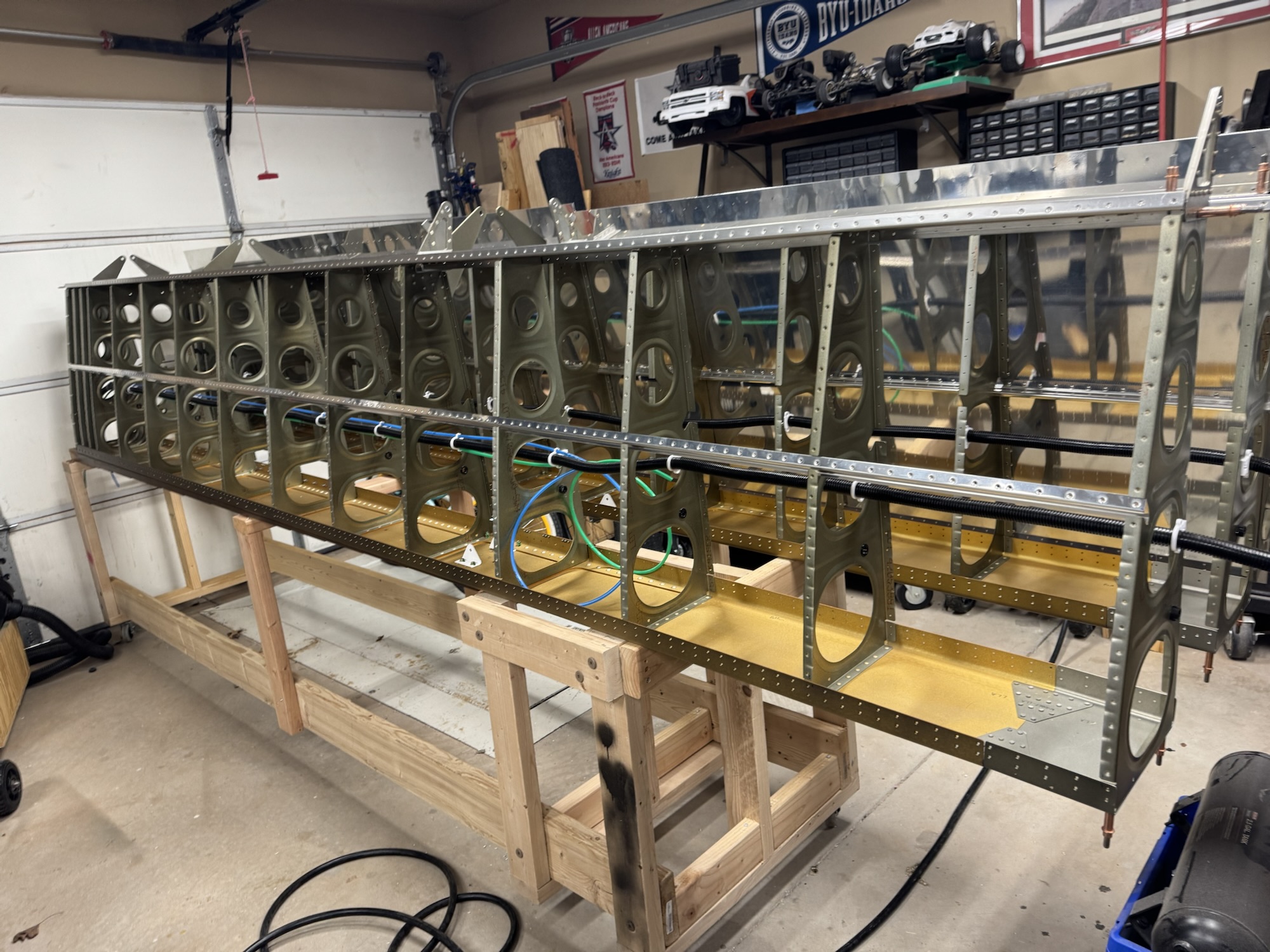
I spent a good amount of time finishing the right wing skin which is ready to go now for priming and riveting. The left wing ribs and spars are also completed. Not much else to report at this time.
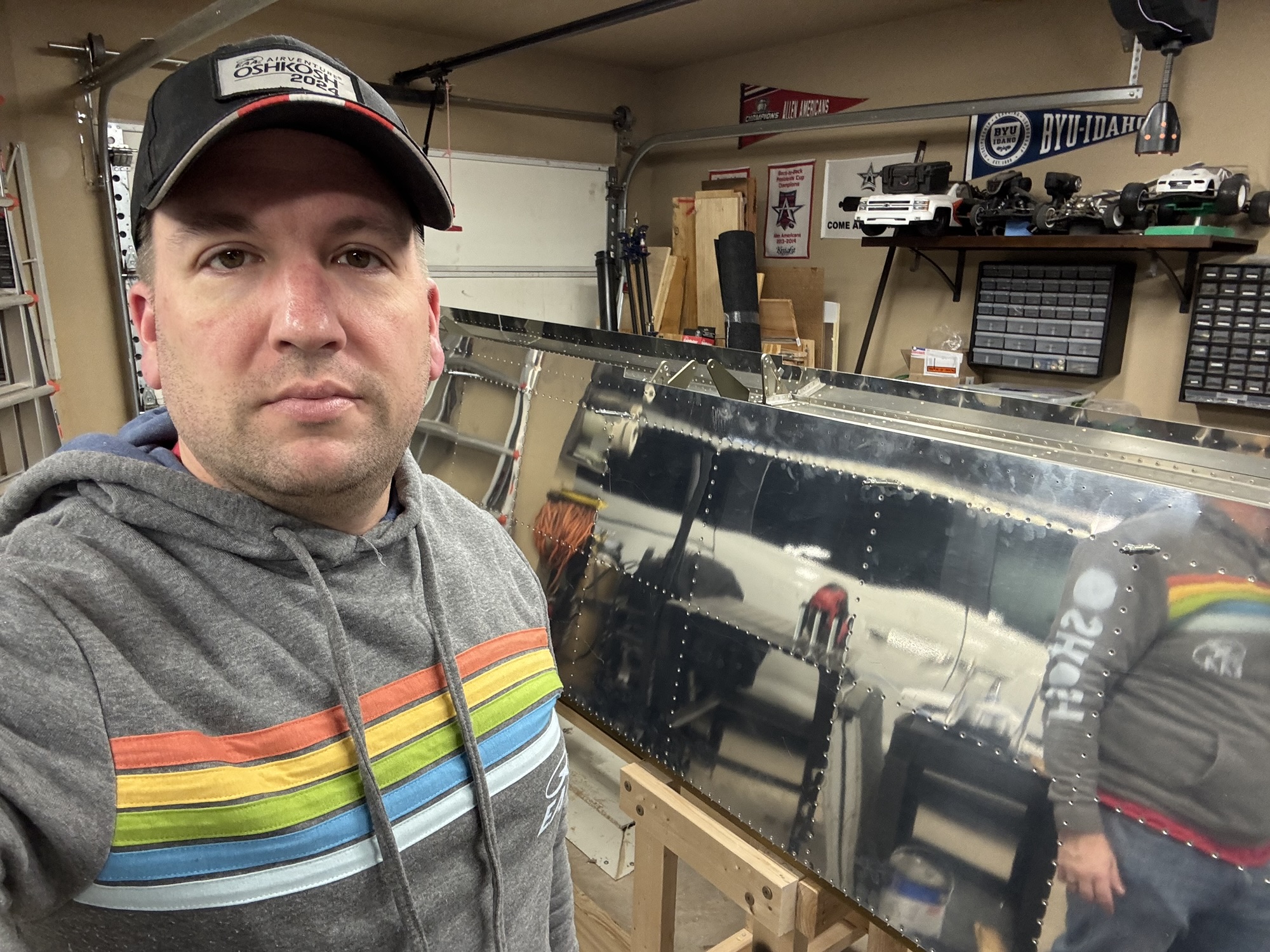
This will probably go over multiple days per wing but I got all of the dimples completed for the largest skin on the top of the right wing today. Alot of monotonous dimpling while listening to podcasts. I noticed I’ve not been including enough pictures with me in it per requirements so I’m going to try to include more of myself in it.
Finally got a chance to work on the plane without having to worry about school work. I’m sooo close. I got all of the counter sinking completely done where the skin doubler and skin come together as well as the #8 screw holes. I also was able to finish the small amount of dimpling it had as well.
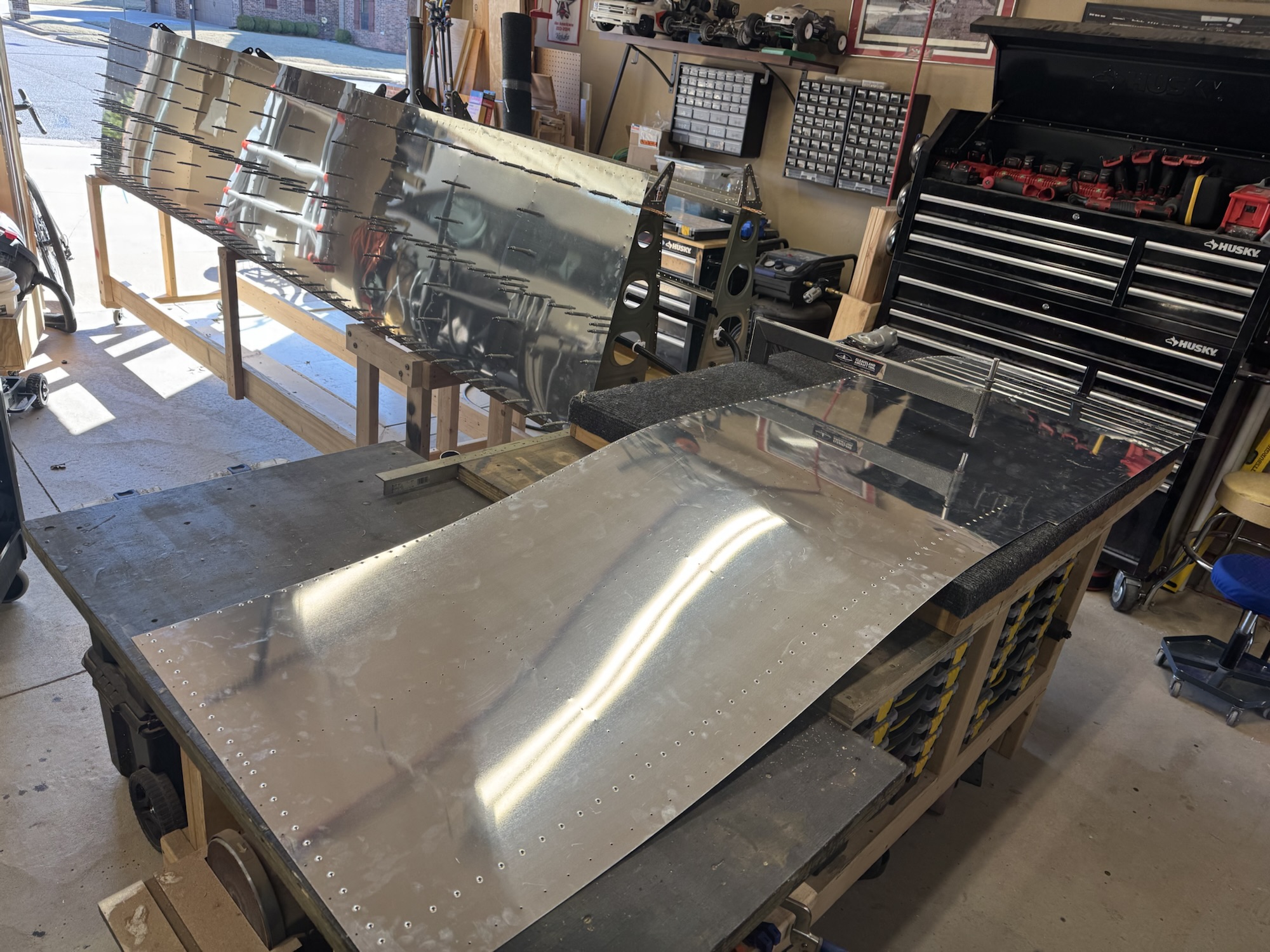
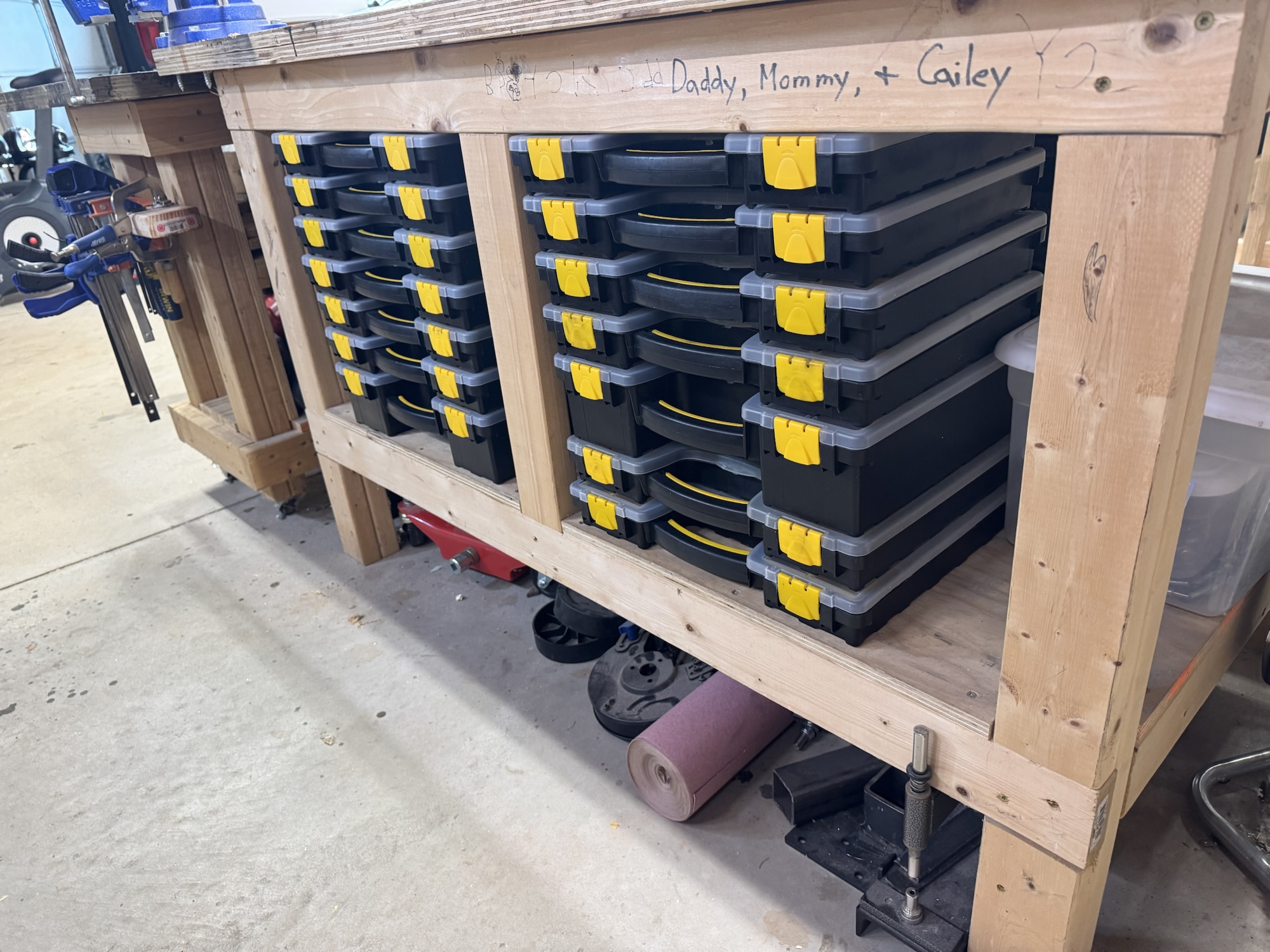
I’ve been extremely busy with church related activities as well as trying to improve my own processes while building. I am constantly dealing with my poor organization of my hardware (minus really my aviation hardware which gave me an opportunity to try things out). So I finalized organizing all of my hardware so I have more space to store tools and other items out of the way while I am building, like my bench vice, grinder, bench sander, etc. I also organized my clamps which was simple with just a 2×4 with some pocket screw holes added to my existing cart, which this also cleared out more space for tools. I also put in a shelf on the wall for my larger items like my drill press and bandsaw so I don’t have to store it out in the shed and it will be close by for me.
Hardware storage
More hardware storage
Shelf for large items
Clamp storage
I also got a call done with Van’s builder support. They were extremely helpful and deep in their explanation on the design of the airplane and other things. Long story short, the hold I drilled accidentally is fine to be left there. I will just need to swap the hardware for the nut plate from the MS21051-L08 to the K-1008. He said I can use a spare piece of aluminum as a backer for the nut plate to go against on that side since there probably won’t be enough material in that place. I’ll have to take a look at that closer when I get a chance. The other item had to do with the holes for those nutplates being close to the edge. He stated that this is acceptable since it is just holding the nutplate in place and that they had changed the design of the part. So I am good to build on and not replace any parts! Hopefully here soon I will get a chance to get more time allocated to this when I finalize my capstone for my WGU MBA in Information Technology here soon!
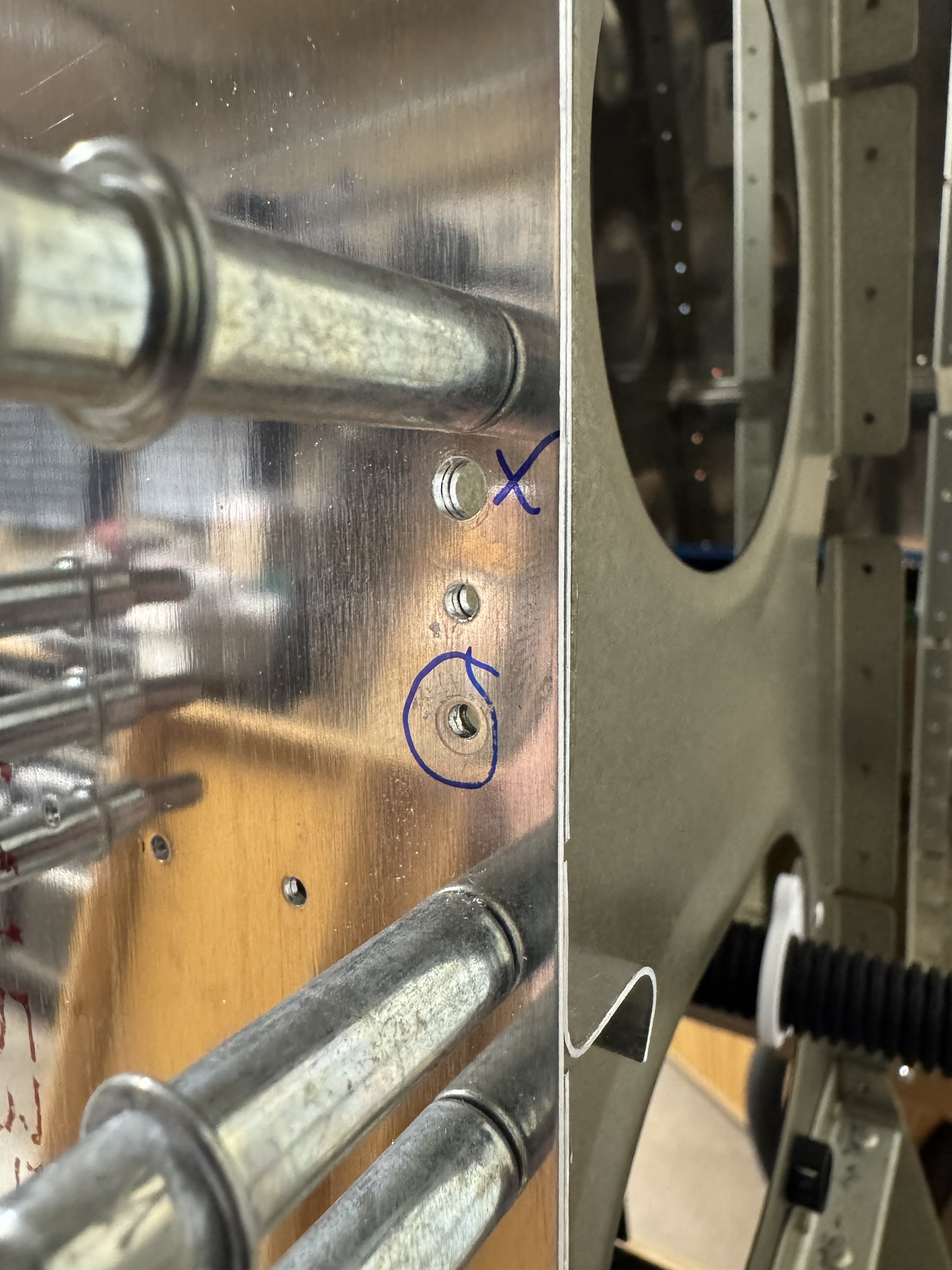
There are two questions that I now need to bring to Van’s on Monday when I get a chance. First off, as you’ll see from the image below, I drilled the wrong hole for the bolt that will hold the fairings on to the airplane between the wings themselves and the fuselage. I thought these were just standard nut plates (which 7 of the 8 are) and I simply drilled all the ones I saw in that pattern…. Unfortunately this one near the J stiffener is a different type of nutplate (one that has two rivets then the nut rather than a rivet-nut-rivet combo) This is a pretty expensive mistake as I will need to replace the inboard rib, the reinforcement skin below it, and then the inboard top wing skin. This will set me back about $200 each wing roughly and that’s without shipping. I’m going to talk with Van’s first to see if there’s anything I can do. Since the nut plate will still have one rivet to hold it in place, and it isn’t structural, there might be a way to save this mistake. I have learned from this mistake that I need to basically check off every single hole and not make assumptions from the majority that they are all the same. They had clear identifiers for how many holes were between each bolt hole so I could have counted that way. Luckily I checked afterwards otherwise I would have happily built on and riveted the skin on and everything.
The second question goes back to when I got my laser-cut part replacements. I noticed that the replacement inboard rib had many more flanges than the original did. But I saw that it was still labeled as a W-1010L/R so I went ahead with it. Unfortunately while i was drilling the holes for the nutplate attachments I saw that two instances had way too little material between it and the edge. I’m going to have to verify with Van’s if this was the correct replacement part and if it is then is it acceptable to have this little amount of material between the rivet and the edge of the part. From what I’ve read it isn’t acceptable in any circumstance and could lead to cracking. Maybe this part was mislabeled and sent to me? It is the proper thickness material though (0.032″) and it works except for that one issue. I should have kept the laser cut ones I originally got just to compare it even more against now that I’m seeing this but… I try to keep my work space as clean as possible and if I leave extra parts that I don’t need around anymore it would quickly get overrun. We’ll see what they say on Monday and whatever is best is the way I will go. If it is the expense route, so be it. I just want to build this plane properly.
I spent just a small amount of time making sure that the holes for the skins and the ribs were already final sized. I picked a few random holes and they all were exactly the size they need to be. I spent alot of my time over the past few days reorganizing, getting some tools that will help alleviate some issues and doing some research.
First, my plans binder is getting too full. I ordered a larger one and got it split out with tabs now and with some plastic sleeves for putting pages in from service bulletins, purchased item manuals and installation instructions, etc. I’m just waiting on the bigger binder now to come in and I’ll transfer all of that work into the new binder.
Second, I ordered a few additional rivet sets that I found were going to be helpful in elevating my build quality. First was the Boeing rivet set. It is a truly flush rivet set with a polyurethane rim. My previous flush rivet set that I’d used the most had a thick rubber cup around the outside of it that solved my first flush rivet sets issue of moving around on me, but it added a new one where I couldn’t see in to make sure I was directly on the rivet and not setting a rivet slightly high in the hole. This one has the transparent polyurethane rim that will let me see through to make sure I’m on. Also, it truly looks like it is flatter than the previous two sets I had. They were just so curved that it was difficult to stay directly flat on the rivet without constant monitoring. I guess I just need to bring my boys out more often to help me rivet LOL.
Third, I ordered some 7.5″ and 10″ AN470 rivet sets. The offset rivet set is just not functional and I feel like I’m losing power to set the rivets. It took me about 20 seconds of riveting to set the rivets this last time, but without changing any air settings I could set a rivet in 2 seconds with the straight set. So hopefully this will decrease the wear on my body while trying to set rivets in those harder to reach places. I also read from a forum that if you use some tape on the offset rivet set then that is also helpful. Fingers crossed this works.
And fourth, and the most expensive of all was that I bought a 3D printer. I bought a Bambu X1C which will be coming in February. I’ve seen from Allan Glen’s build logs that he has printed many parts, jigs, and tools that help him be accurate with his build and make things function properly and look cleaner. I’ve already used some of his prints but I was having a friend print them. I didn’t want to bother him too much so I decided to get my own. This way I can print tools or jigs and if they are slightly off and need reprinting I don’t have to bug anyone and I can have it redone in a short amount of time. I picked the X1C because it was reviewed to be easy to use with little tweaking and it could also print in polycarbonate, fiberglass reinforced, as well as carbon reinforced materials. Fingers crossed this will not be a waste of money, but my friends at work and at church have all said that they’ve been printing so many things to fix things in their life or to make a solution that doesn’t exist. I also have my son, Andrew, who has been taking a CAD class in high school for the past year and a half so he should be able to show me the ropes in the CAD software.
I also found through Allan’s page that there is an avionics wiring class from the Aircraft Electronics Association called “Avionics Installation for Experimental Aircraft” that they host in Kansas City that is basically a three day course on how to plan, design, and implement your avionics solution. I really want to take that course and since it is fairly close to home, we might just take a small family vacation up there this summer so I can take the class and the kids can go around and have fun.
And finally, one thing I don’t want to forget is Allan mentioned using this 3M Scotch-Weld DP2216 Epoxy Adhesive for things around the airplane where you don’t want to use the ProSeal. I’ll have to see where I might use it instead but I at least want to document it in a post so I can reference it again in the future.
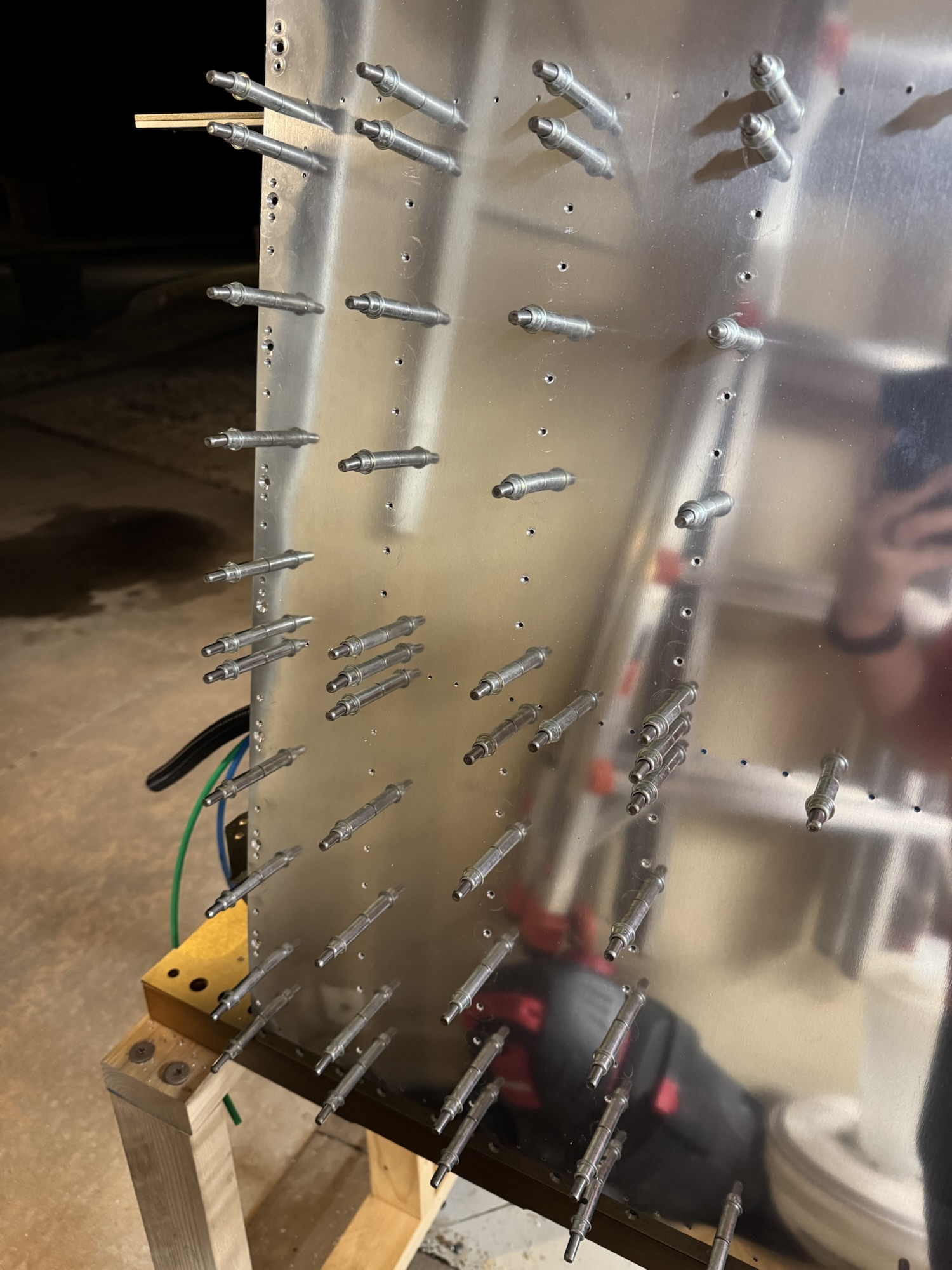
I decided to at least get a peak at how well the skins fit today by clecoing them on. It took a bit of time but I got it on successfully without any major issues.