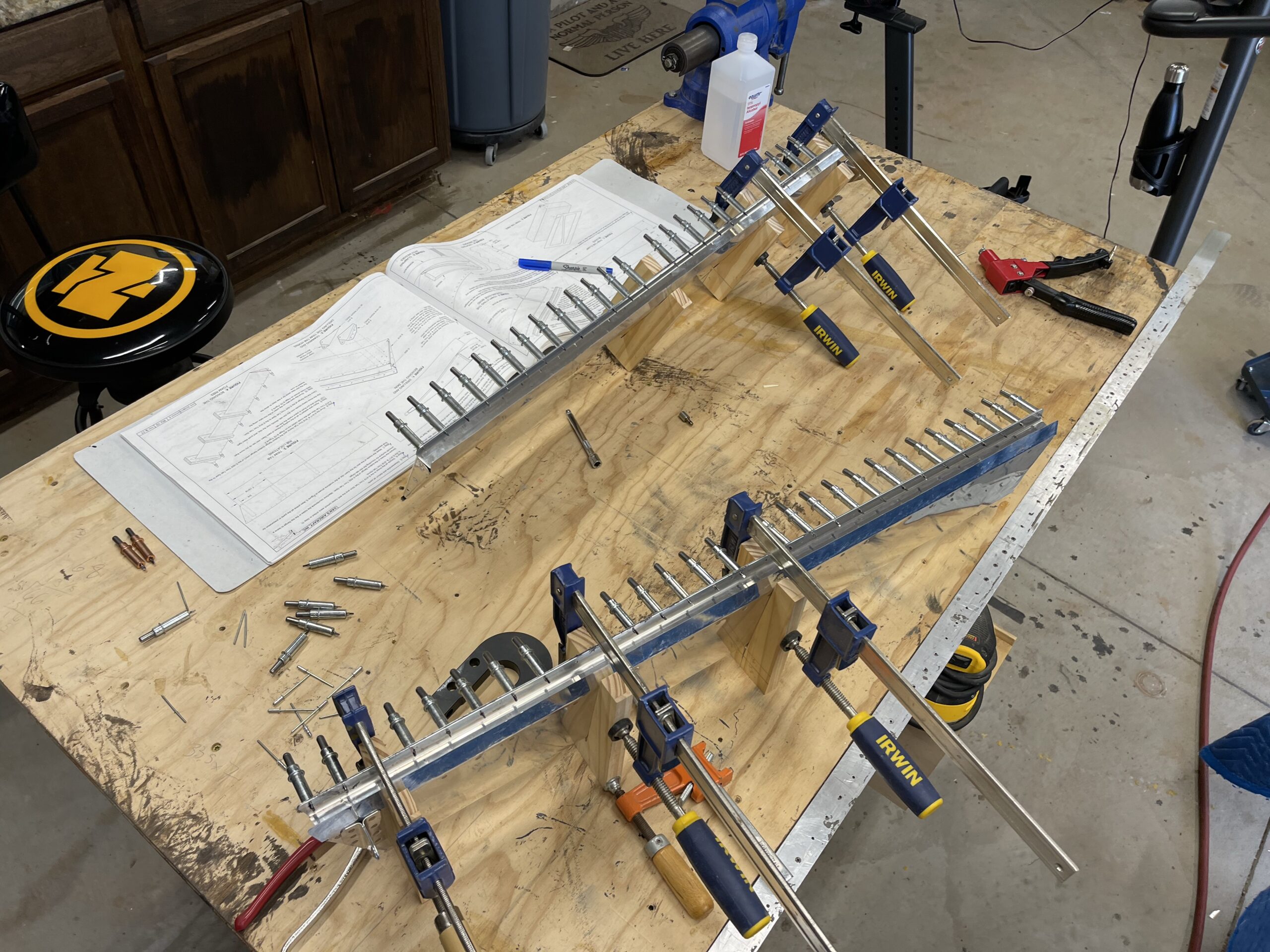
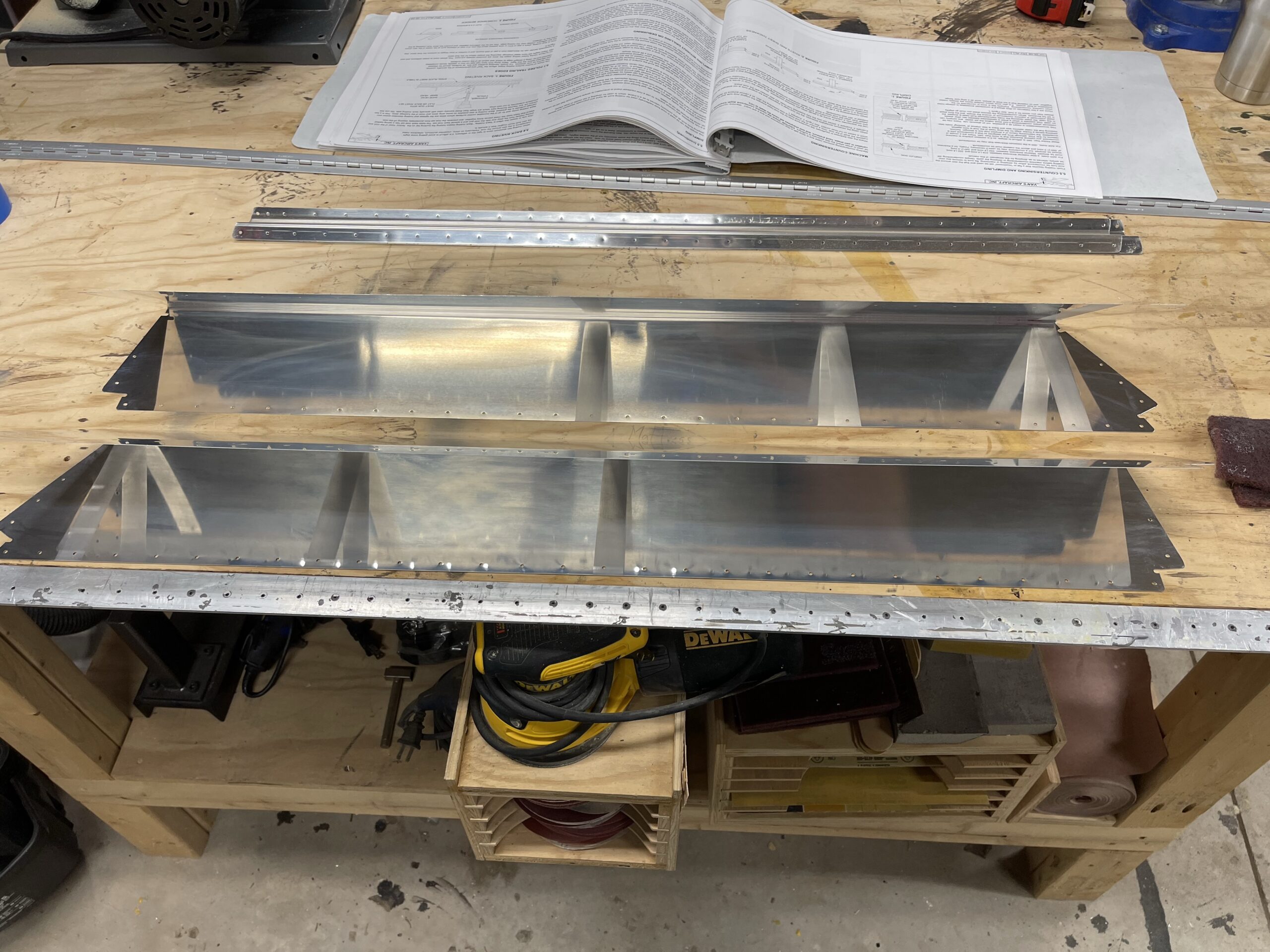
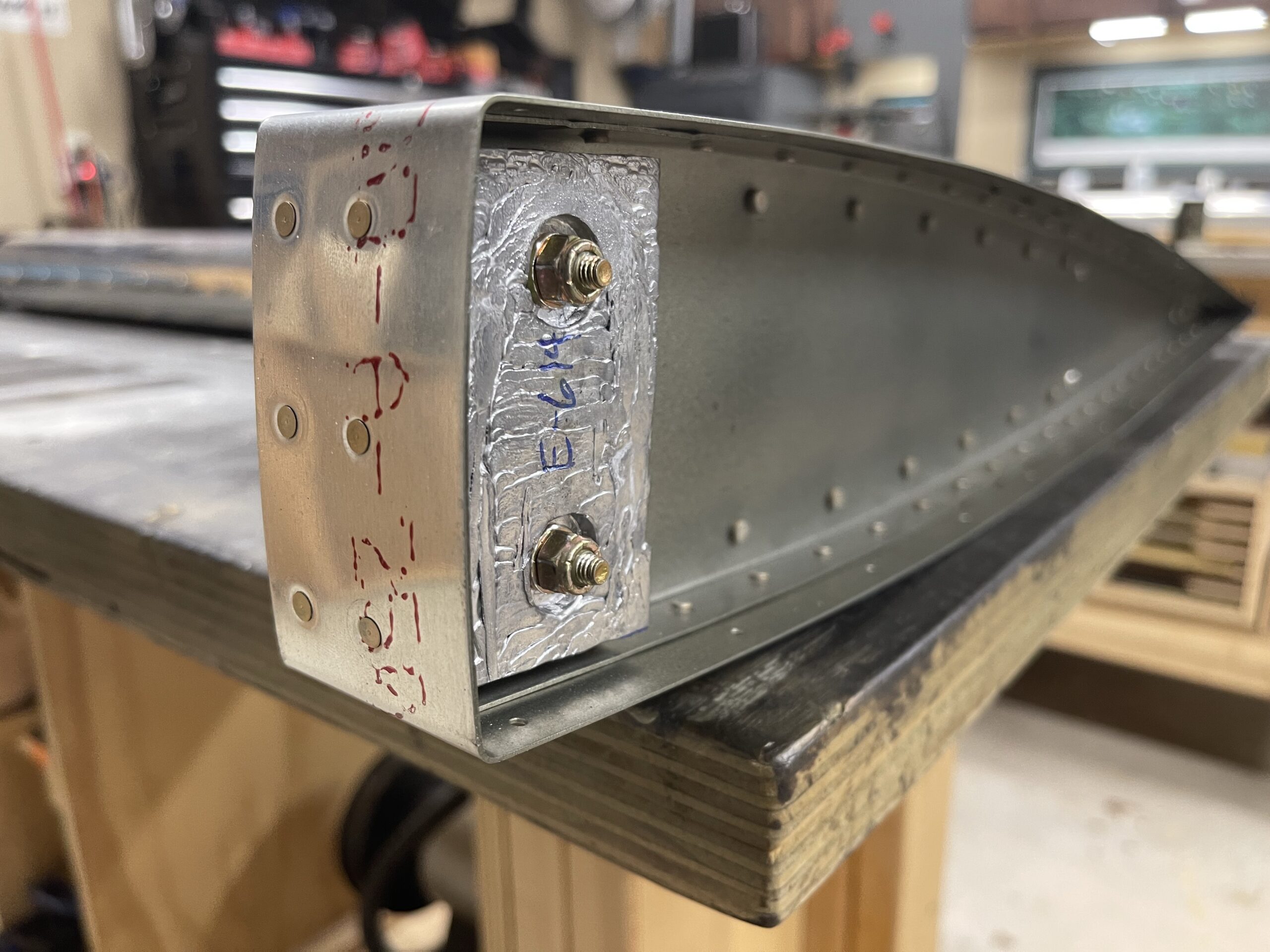
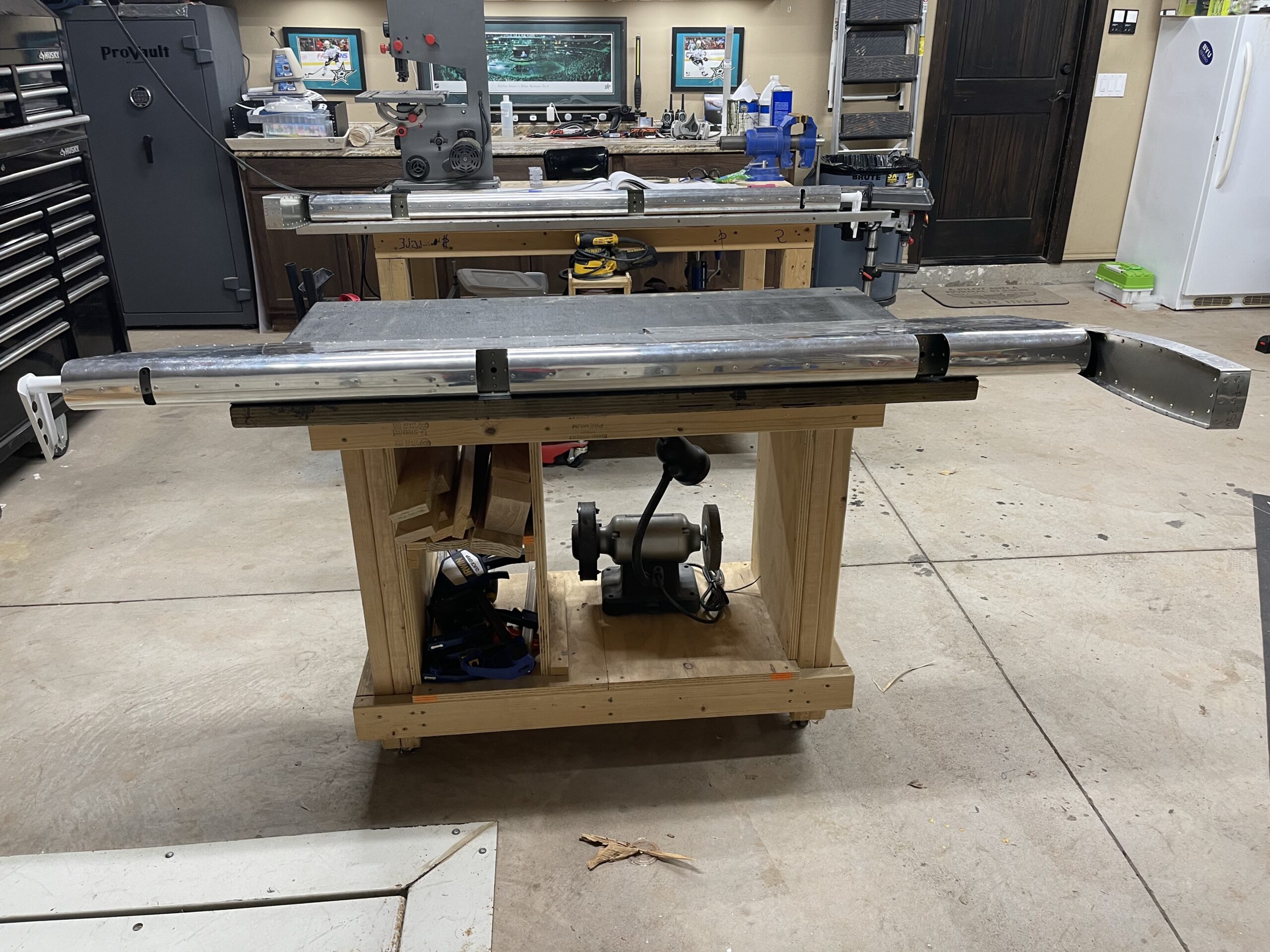
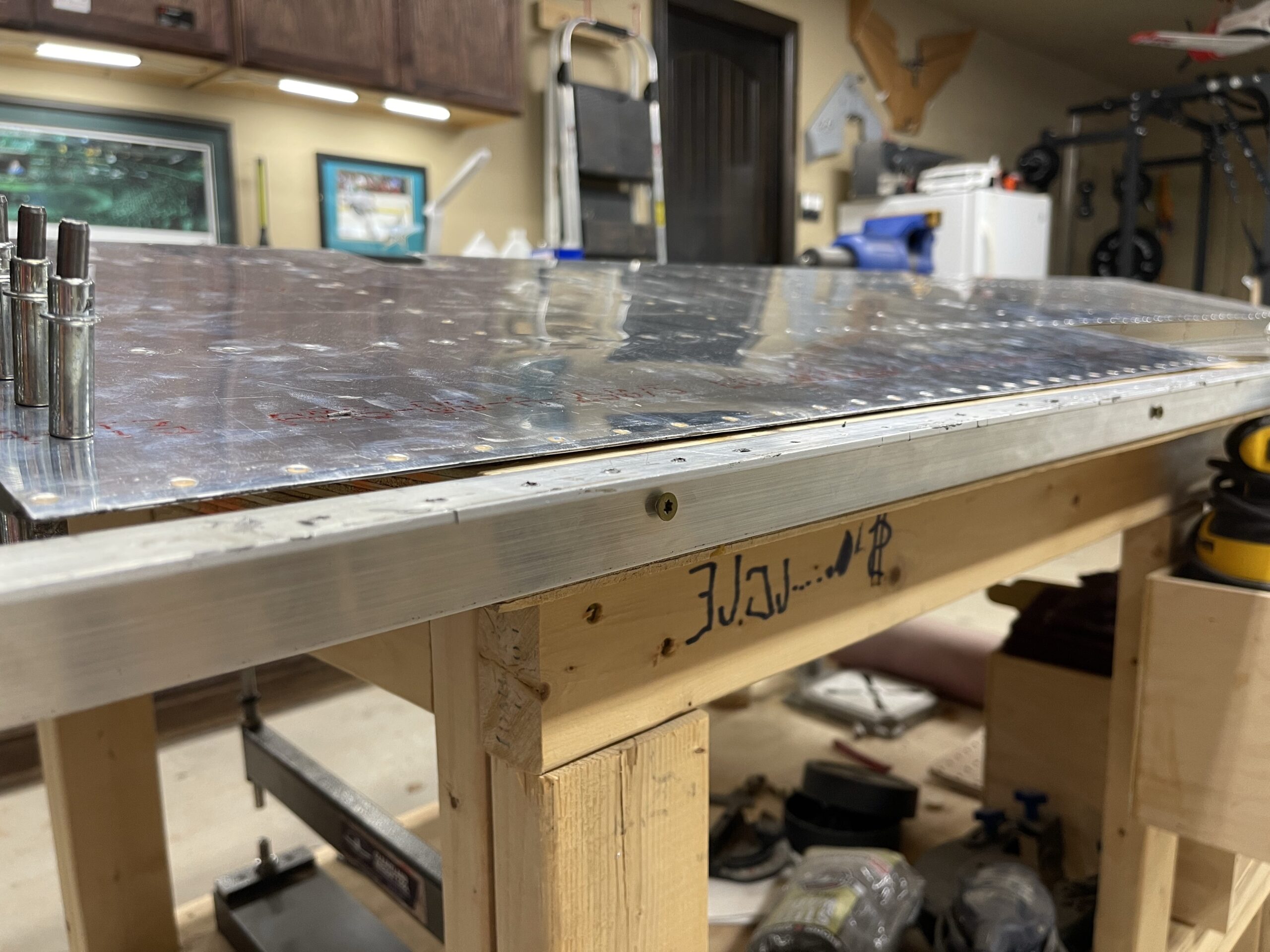
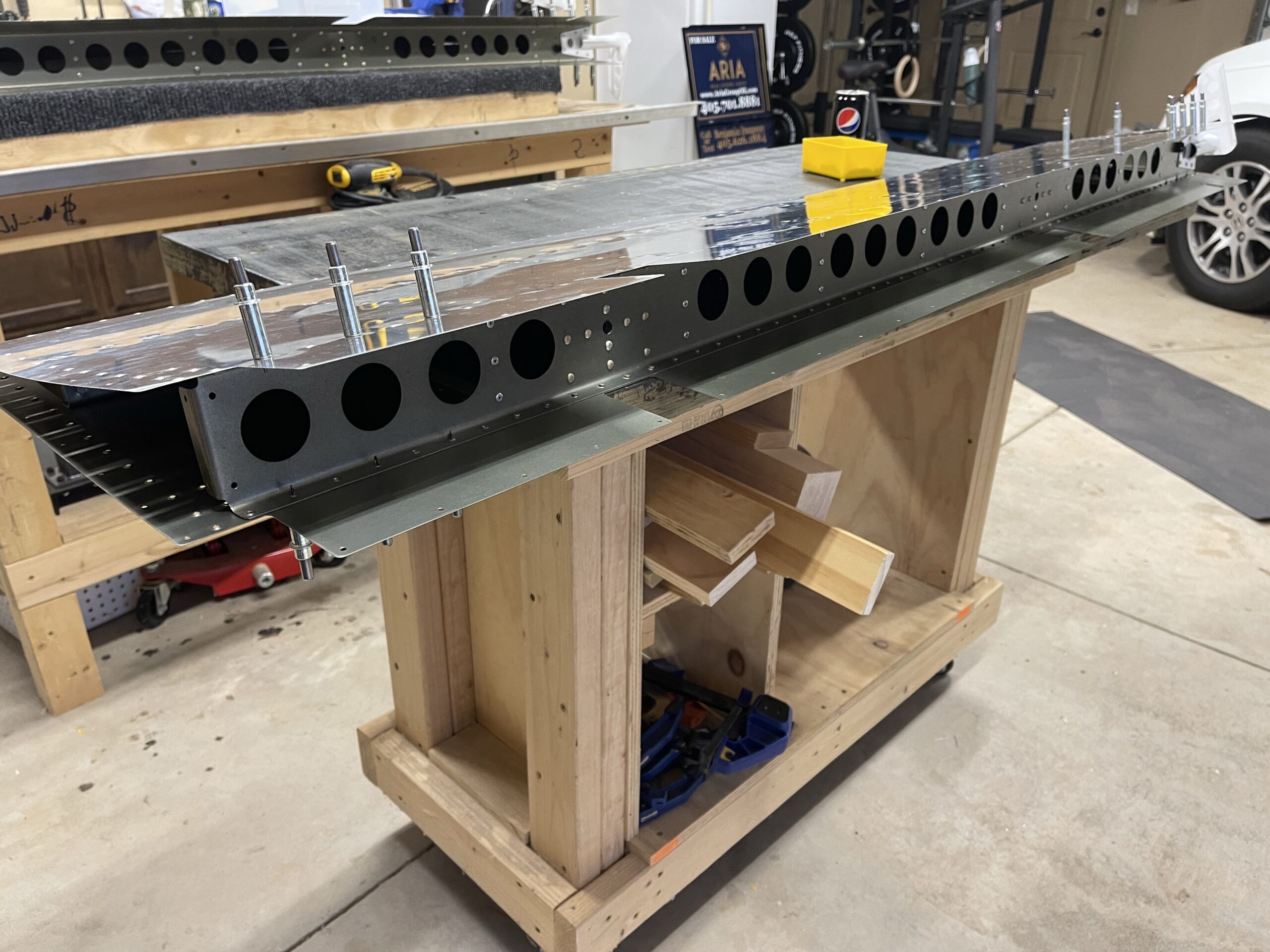
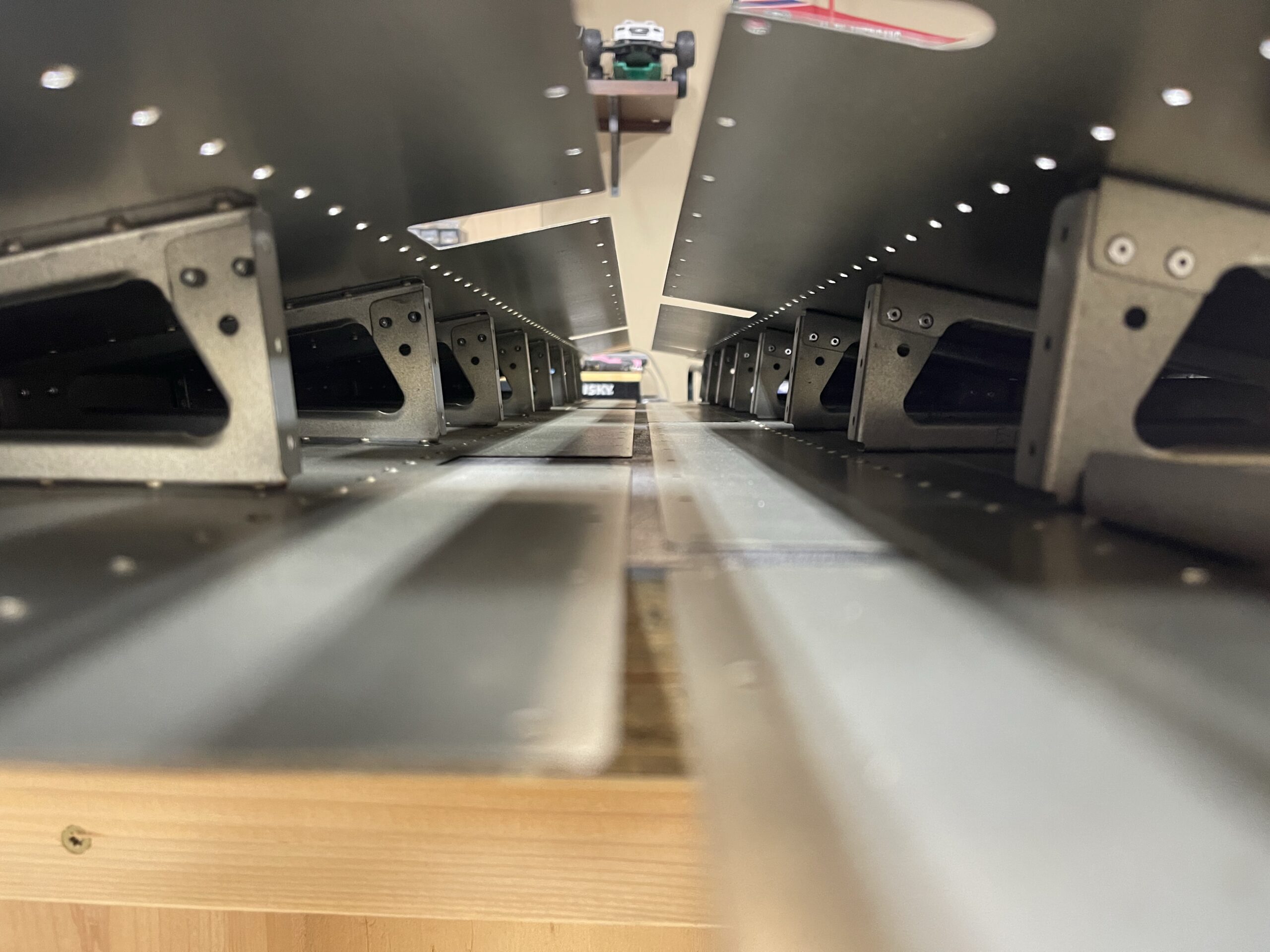
I spent some time on Saturday and Sunday getting the trim tabs sealed up and I at least drilled the holes for the elevator side of the trim tab hinge. I’m going to have to wait until Thursday to do the rest of the hinge drilling on the trim tabs since I have church visits on Tuesday night and then Mutual on Wednesday. I just got it sealed up last night and I want to let it sit for a couple of days like the instructions say so that it cures properly on those foam ribs and tank sealant. But I’m almost done though with the elevators and then I can get on to the tailcone. I want to get as far along on that as possible since the wings should be shipping any day now.
Trim tabs riveted and sealed. Just need to let them cure nowHinges drilled on the elevator side. Need to take them off and deburr the drilled holes.
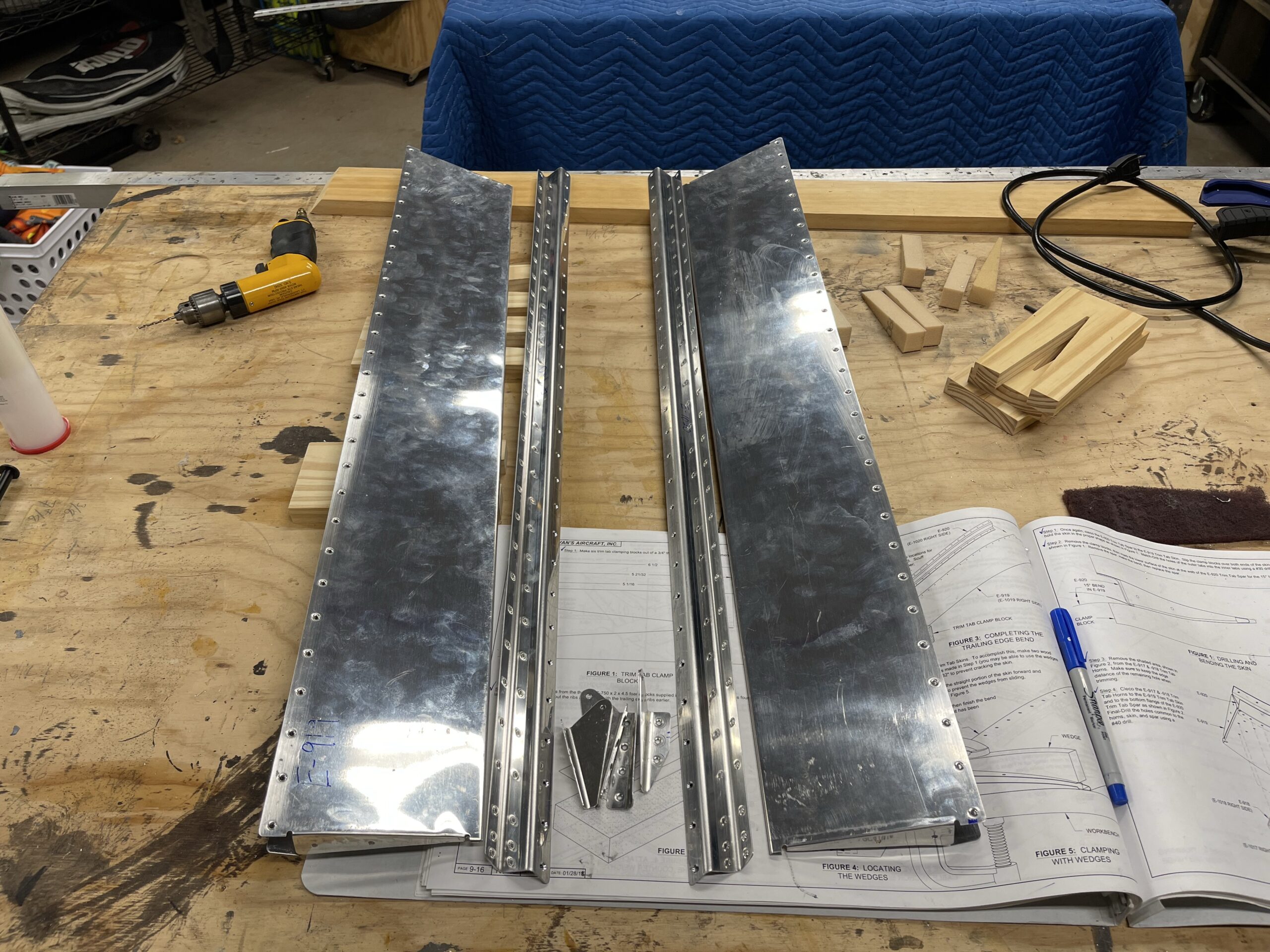
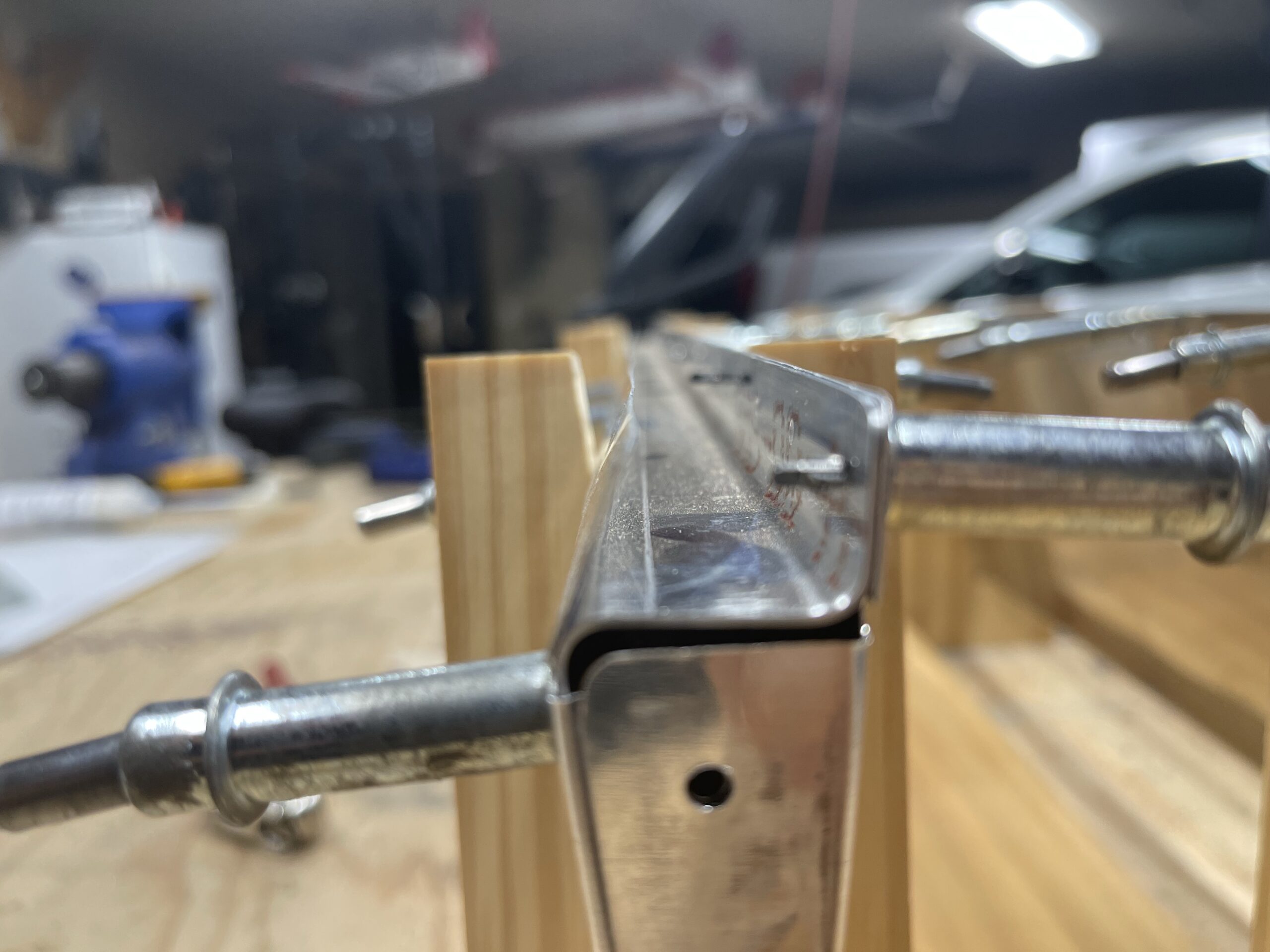
I spend a little bit of time this weekend working on getting the bend right on the lower portion of the trim tab skin. My initial go at it was still kind of wavy. I went to bed but didn’t like how it turned out. The next night after work I sat in there and really worked up and down getting the waviness out of the bend and the second go I feel look much better. I’m not a pro but it looked straight to me and seemed smooth enough. I used my snips to get the majority of the material off of the control horns and then cleco’ed them on. I will finalize the material removal on the deburring wheel when I go to prep the parts before dimpling. I am going to do the final size drilling tonight which shouldn’t take too long.
Another update on the wing kit! It’s all paid for and I got an email that it was crated while I was at Oshkosh and they are working on shipping arrangements. Curious to see what those shipping costs are going to be. Might be cheaper for me to take a few days off and go drive to pick it up lol.
First try – picture #1First try – picture #2Final go – much better!Horns cut and cleco’ed. On to final-size drilling!
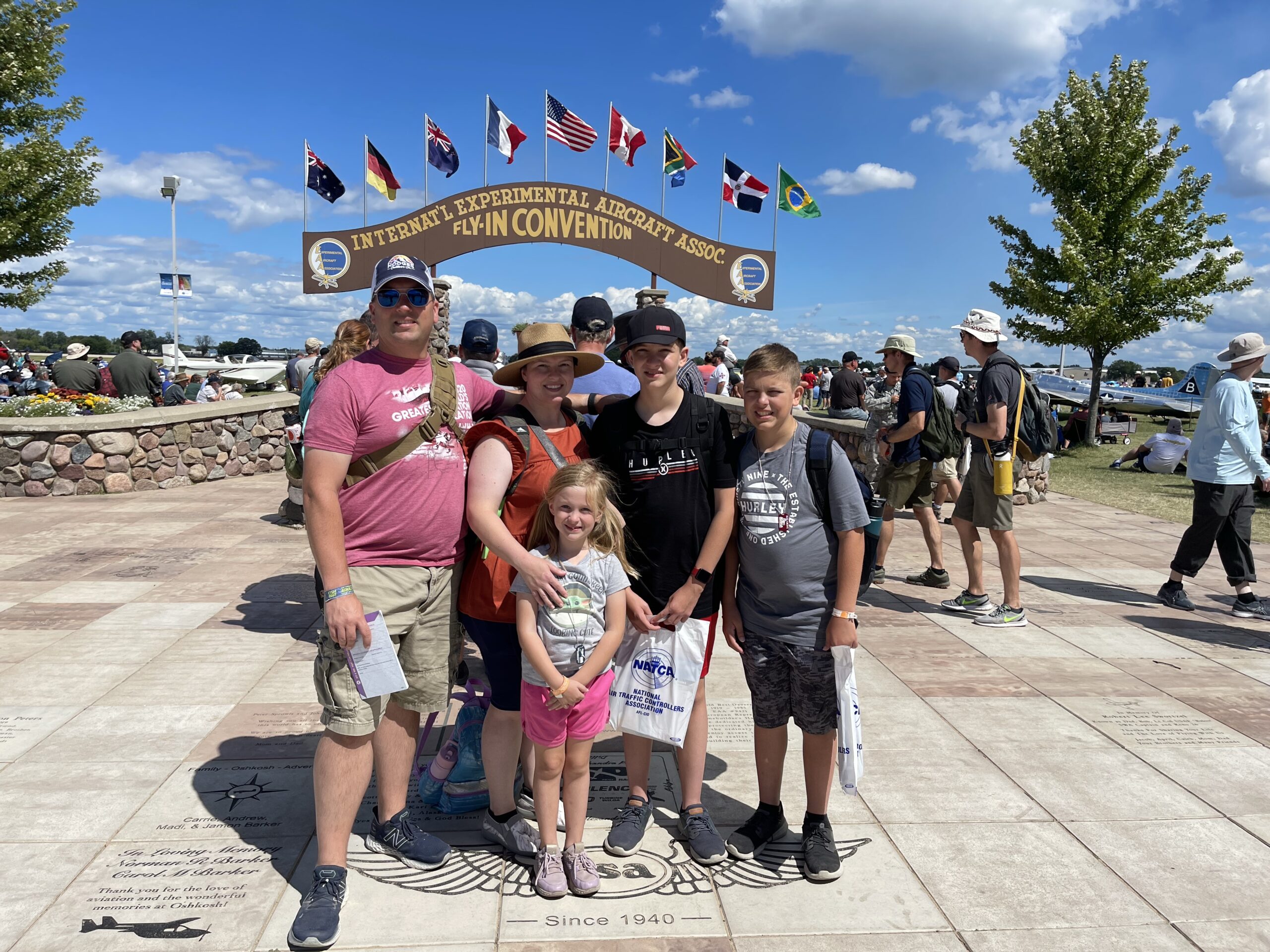
My family and I went to Oshkosh this year and stayed the entire week (Mon-Fri). I am overwhelmed with how much there was to look at, watch, and to learn about while I was there. I wanted to list some of the key takeaways from Airventure and lessons I learned for future reference in this build.
Engine Selection
I got a good chance to look at the Lycoming engines and the different options they have. I thought an IO-540 was an IO-540 but they have a ton of different submodels. The D model is what Van’s recommends and sells, but I’ve seen in forums where some users are using the K model. I also found a plane that was using an X model but I am not finding reference to that on Lycoming’s information. I’m going to have to search around on the Van’s Air Force forum or other places to see what that engine is. I couldn’t find the owner as it was just parked out there and I even waited some to see if he/she might return but no luck.
They had the IO-580 on display which had the exact same dimensions as the IO-540 except for it’s height. It was 2 inches taller. But the power you got from it was very impressive. It was achieving 315hp in almost the same footprint. I decided to not go with it as it is not what Van’s recommends, and after reviewing some of the Van’s forums there were some issues with running the recommended props on anything higher than 300hp. I am looking to get as close to the 290hp I can get though which I am looking to see about that K model IO-540 and if it is worth upgrading to, or should I just stick with the IO-540-D since it is cheaper.
I also read through their marketing for the Lycoming EIS. It is definitely super nice, but it looks like they designed it to replace existing magneto based installations and not brand new installs. So this might not be something I get but it was cool to see and learn about.
Avionics
I visited with vendors from Garmin, Avidyne, Advanced Avionics, and Dynon. Garmin was the most complete. They sell everything you would need to make this function so it’s almost like an easy button to get your avionics suite setup. I am almost much more familiar with their products as I’ve flown with them since I started flying either with the G1000 the 430s or the 650s. I was also very impressed with their Garmin Pilot EFB! I had never used it before but it was very well done and might be something I switch to if I end up going Garmin in the plane.
The next I was impressed with was Avidyne. The look and feel and usability just seemed more fluid and I already understood how to use the majority of the system because their IFD550/545, IFD540/510, and IFD440/410 looked almost like a Garmin 430 and the larger 530. But that was also my hangup. I’ve gotten more used to the GTN650/750 which has more screen real estate and fewer buttons. It just felt a bit dated with those buttons on the outside. But I could also see the advantage of keeping those buttons with getting quick and tactile access to commonly used functions. They also had the IFD100 iPad application to go with it that made remote control of the radios much easier even in turbulence if you could just use it on the iPad. I didn’t like their PFDs as much, but they were okay. Avidyne did not have a complete package as well. You would have to work in a hodgepodge of different components to make it work. This might not be as bad as I’m thinking it would be, as my current experience of working with multiple vendors to make a single solution to function properly constantly has each one of them pointing fingers at the other. I’m imagining this would be the same situation if you had an issue between these disparate systems.
The final one that I was interested in was Dynon. I really loved their PFDs. These were super nice and I loved the angled button edge which would allow me to perch my fingers on during turbulence. They also had a really nice refresh rate and made their display smooth. They didn’t have a navigation solution and would have to be supplemented with an Avidyne or a Garmin, but it seems like they have everything else. Their autopilot looked like it would fit the bill for me, the remote radio panels were really nice to segment the radio coms to a separate panel, and I liked how they already had package examples setup for different levels of equipment. Of course I liked the Airliner package as it had some great screen real estate, but I don’t think I would need that third PFD. But the Cross-country Cruiser was also a nice package, but I would just want to add the navigation source like an Avidyne or Garmin. I would want to get people’s experiences around each of these different platforms before I made a final decision. Garmin was a bit more expensive, but they are also giving you a full platform to implement and they are also using newer and faster communication styles such as Ethernet with Serial backup.
Below are some Avionics installs that I liked and their placement. They all had good cockpit flow to them and some of the commercial ones I’m imagining they have put alot of research and development behind to make sure the flow was good.
Propeller
I had a really good and lengthy discussion with the Hartzell team in regards to the propeller and how I should select it. He stated that getting a two blade prop would give me good top end speed but sacrifice takeoff performance, while the three bladed prop would be the opposite. I honestly have never looked into those details so it was really good to get some details on why I would select one prop over another. They didn’t have any printed material for me to look at but they showed me that they have details on their website regarding specific props for the RV-10. They also suggested that I talk with Van’s as well as go through the forums and see what other’s have done and how they feel about its performance.
Lighting
I was absolutely sold on the AeroLED’s solution that they worked on with Van’s Aircraft on their new carbon fiber wingtips. The AeroSun VXi wingtips are going to be an almost all in one solution for my lighting with its NAV, ACS, POS, and Landing/Taxi lights all in the wingtip units. The only additions I would want is the Suntail light for the back of the rudder as well as the Sunbeacon II for the beacon light. But I’m still mulling that over as they stated these wingtips will meet the requirements for lighting across the board. The fewer cables I have to run and lights I have to support the better.
Avionics Installation Partners
I spoke with Aerotronics as well as SteinAir. I was very impressed with SteinAir in regards to the existing portfolio of RV-10s they have done and the amount of interior design parts that they have designed and support, outside of just the avionics panels. But I don’t want to rule Aerotronics out as they did have a good presentation as well in regards to their experience and capabilities. They were familiar with all of the products I wanted to install as well if I went with Garmin, Avidyne, or Dynon.
Paint
I got some awesome ideas from just looking at the different RV-10s that were out there as well as just any airplane I passed by. But in regards to working with any third-party to help design a scheme I talked with Scheme Designers and Flight Lines. Both had really good portfolios so I’m kinda split on this. Plane Schemer was not there or I missed them, but I’ve been working with them before and they also have an awesome portfolio. If I had to pick today it would be either Plane Schemer or Scheme Designers just for the portfolio experience and designs I saw. Flight Lines was good but their portfolio seemed to be more simple in their designs.
Awesome RV-10s I Saw
Here are some of the amazing RV-10s I saw and I’ll talk about what I liked the most about each of them.
This plane had some super nice features that I wanted to replicate. First off, I love the cowling. I was talking with a gentleman that was with me looking at it that has an RV-10 already and he said that the Vans cowling can allow it to get a bit hot sometimes since it’s cooling isn’t as efficient as this one. Apparently this cowling has a duct that goes directly to the cylinder heads instead of having an open area that you have to put in those rubber barriers to keep air where you want it. I also liked his three blade prop. It was super nice carbon fiber and I bet it is pretty light weight. I’ll have to look into that. I liked his gas cap covers for some reason lol. It just looked super nice and clean. And finally the cowl was put on with screws. The gentleman I was with said that the piano wire hinges that they have are susceptible to breaking. I’ll have to look into that as I didn’t quite like seeing so many silver screws out there as it took the attention away from the red color.
This was a really nice design, though I think i would like a brighter contrast. It’s not showing up well in these pictures but that white was more grayish. I would want a very solid white there to pop against that blue. That blue was a very pretty color as it was very metallic. It was a really nice paint scheme though.
This plane scheme was really nice if you wanted to go dark. The flowing lines worked really well, even though you couldn’t see all of it with the cabin cover on. It was really pretty though. That red if I’m remembering right had an orangish tint to it.
This was the coolest from just a design perspective. I would not want my plane painted this way but it was a piece of art! It had a section of the plane devoted to each of the armed forces. It was a really cool idea and I think it was done well!
Finally, each of these had really good components to them so I’m just going to group these together. Enjoy looking at all of the different RV-10s we saw!
I got the trim tab holders cut out from some spare wood that I had laying around. Even though I had to cut them by hand instead of some kind of template, etc it still came out pretty good. After doing all that work I realized I should have used some double-sided tape to stick them all together and then cut them all in the same go. Hindsight is 20/20. I also got the skins prepped for the tank sealant that will be used with the foam ribs. After that I got all 6 ribs cut out from the foam. I need to stop by Lowe’s to get a 2×8 and some hinges to make the brake that they mentioned in section 5. Hopefully I’ll get some time to get that done tonight before church.
I got a short amount of time last night to get the weights trimmed a bit more and install them. I’ve never worked much with lead, but it was amazing how easy it was to cut. I got a box cutter to trim the burrs off of the edges and it cut through it super easy. Amazing how well that worked! I even took the advice of some people from the Van’s Air Force forum and used a chisel for the large amounts that I needed to trim. That also worked really well, but I’m glad that I used the bandsaw to cut the major parts as I think the chisel would have taken forever for that work. I was surprised they didn’t have a torque spec for the bolts so I just got them snug (not tight, but snug; which was more difficult to get snug than you think since the holes through the weights were pretty tight and it was hard to judge that)
I got a tiny bit of time to get the front edge of the elevators rolled and then riveted. I also got the change to cut the basic shape of the counterbalance weights. I still need to get them smoothed out some and grind off just a tiny bit more. The band saw worked pretty good but the metal cutting band kept getting gummed up with the lead from the weight. I’d have to stop and pick it off before I could keep cutting. Other than that it went pretty good and is looking nice!
Both elevators done!Rough cut for the weights. I don’t like how these weights are all wrinkled
I got the trailing edges sealed up today. I put the pro seal on on Friday and it sat all weekend long until today to cure. That was basically just over 36 hours. I’m getting better at trailing edge work, but I still slip with too much pressure through the rivet gun and end up marking the skin around the rivet with the back riveting set. The back edge was very straight on both of them. One had a very slight bow downwards in the middle of it, but it was VERY minimal, but noticeable to the naked eye. I did notice one additional oddity. On the right trailing edge on the outward side it is slightly bending upward. The edge is straight but it’s straight up a tiny but. It’s so weird because the skin is pretty flush on the end, but I guess it’s off just enough to make it curl up a bit on that end. But again it’s straight along the back end and I doubt these small errors will cause any major issues. I will say, I am curious how much it will affect the mating up of the elevator tip with the elevator itself since it has that small curl. But we’ll see when the time comes I guess.
The pro seal is set and weight is put on it to help it set properly
Super straight with that angle iron (or really aluminum) helping out
The right elevator with the rivets set. It’s hard to see here but the furthest most tip slightly bends up
The left elevator, it slightly dips in the middle, but is looking great!
I spent my time after work finishing up the riveting on the rear spar and completing all of the front spar riveting. The Cleaveland Tools bucking bar was awesome! It follows the design that Van’s Aircraft puts in the manual and I can see why they have that. It was perfect for the rear spar and I actually got more consistent rivets out of it than my normal bucking bar. I didn’t take a picture of this but I went ahead and put on the elevator tips to see if they would straighten out some. They did, but they still aren’t perfect. I’m going to have to attach the elevators to the horizontal stabilizer to see how visible it is and if it affects the movement of the elevators.
I spent alot of time this weekend getting to where I am now. It started on Friday afternoon with dimpling more skins, deburring a bit more on the skin edges, and just getting all of the parts ready for priming the following day.
Saturday was doing some of the skin sanding that they ask you to do so that the tank sealant bonds correctly to the skin and the foam ribs, cleaning the parts off (which I accidentally removed some of my marks for reassembly… whoops!) and then masking off areas that I didn’t want to paint. Painting is getting better each time as I dial in the settings. It appears that this sprayer likes about 25 PSI. I’m curious if I should have it dump out more primer the next time and make wetter coats? The lighter coats tend to create a rough surface as it becomes more like little specs of paint that dry rather than a layer of paint that dries smooth. Spray painting is such an art with so many variables in it.
Assembly has gone very smoothly so far. I did change up the steps a bit on riveting the two elevator skins together. I used the method that we established in the rudder build, which Plane Lady actually suggested in her latest video. It made putting the elevators together MUCH easier than having to deal with assembly in that tight area. The rivet gun I have actually would not have fit in there if I didn’t do it this way, as the handles when fully extended make the tool wider than the spacing between the ribs. So their trick to extend the handles with tubes of some kind over the handles wouldn’t have worked out. I checked that both elevators were flat and level and they were so I’m happy there.
The only piece I’m not happy with is the elevator ends with the counter balance weights. I assembled them and didn’t have any issues there but when I set them down on the bench, they both were pretty twisted. I am not sure how that occurred as I made 100% sure at the very beginning of the elevator section that those things were perfectly flat and level and the flanges were perfectly 90 degrees. I will say while I was squeezing the rivets, it did seem to slightly modify those flutes that I had put in some of the flanges. I sure hope that wasn’t the issue. I mean, luckily it’s not a ton of parts if I did have to reorder and redo it, but I’m imagining there’s a way to fix this going forward. I put a video of it here on this post.
This thing and the hose I use with it are heavy. Have to take breaks often with this thing
Up close of the dimpling on the ribs
All of the parts dimpled and ready for skin prep and painting the next day
Some skins I had to put on the floor for lack of table space, but they are primed now
The other primed skins
The primed internal parts
Primed counterbalance pieces and access hatch/trim cable pieces
Trim cable/access panel all riveted!
Backriveting prep work: rivets and tape installed
Just one of the skins with the ribs and rear spar riveted
Down the row showing the two elevator skins mated and riveted
This is the weird twisting I was talking about. Not sure how to handle this